


Celonis tops Gartner's 2026 process intelligence ranking
Mon, 11th May 2026
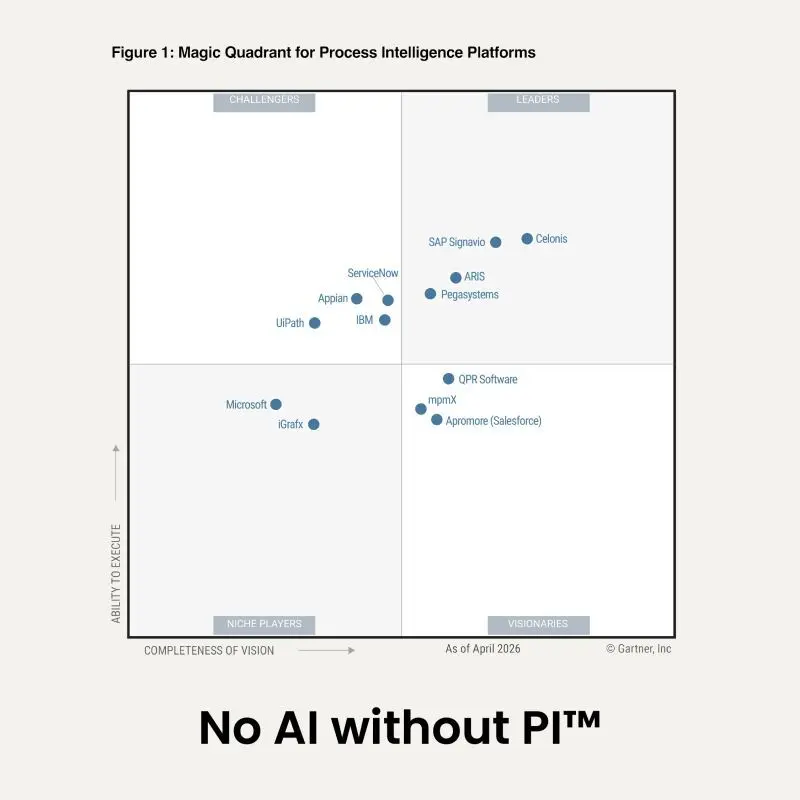
Celonis has been named a Leader in Gartner's 2026 Magic Quadrant for Process Intelligence, ranking highest for Ability to Execute and furthest for Completeness of Vision.
The assessment marks a category change by Gartner, which replaced process mining with process intelligence in its latest market evaluation. Celonis had previously ranked as a Leader in the process mining category for three consecutive years.
The shift in terminology reflects a broader change in how the software is positioned. Process mining has typically focused on analysing historical records to show how work moved through systems. Process intelligence combines that historical view with real-time analytics and predictive insights.
That distinction matters as companies try to connect operational data to automation tools and artificial intelligence systems. Vendors in this market argue that businesses need more than retrospective analysis if they want AI systems and automated processes to respond to current conditions inside the organisation.
Celonis positions its platform as a layer of operational context for business users and AI systems. It describes this through its Process Intelligence Graph, which creates a process-centric digital twin of operations using object-centric process mining.
The company also highlighted tools designed to help customers identify where AI projects may have the greatest impact, and to build and manage AI-driven processes. It also pointed to integrations with data lakes and workflow orchestration tools intended to connect people, software agents and existing automations.
Alexander Rinke, Co-Founder and Co-Chief Executive Officer of Celonis, linked the ranking to the company's customers, partners and staff.
"We are honoured to be recognised as a Leader in the market," said Alexander Rinke, Co-Founder and Co-Chief Executive Officer of Celonis. "We owe this recognition to our customers, partners, and employees who keep pushing the boundaries of the possible. We believe this recognition confirms the importance of Celonis Process Intelligence in enabling our customers to optimise their operations and provide their Enterprise AI with the operational context it needs to succeed."
Customer view
Customers cited in connection with the announcement described process intelligence as a way to give AI systems more reliable business context. That reflects a wider debate over whether large language models can deliver useful results in corporate settings without structured operational data.
Kevin Grayling, Chief Information Officer at Florida Crystals, said the company had concluded that access to data and public large language models alone was not enough.
"We've learned that data and public LLMs aren't enough for our business; Enterprise AI needs the right context to drive intelligent decisions and actions.
Celonis acts as our core intelligence layer, providing the operational context our AI agents need to do the right thing. It's the foundation that allows us to deploy AI that drives the most value across our business," said Kevin Grayling, Chief Information Officer, Florida Crystals Corporation.
Renault Group also described the software as a way to prepare operational data for AI use. It pointed to the role of object-centric process mining in converting source-system data into a structure that AI systems can interpret more effectively.
"To benefit from AI you need good data that's well-structured, and that's where Process Intelligence and Celonis come into play.
Using object-centric process mining, we can go from having the data as it is in the original system to a well-structured model that makes sense to the AI and can be used to give more accurate answers. Ultimately, this combination of AI and Process Intelligence will be the catalyst for evolving our core processes, making them more agile and resilient," said Julien Nauroy, Domain Leader - Process Intelligence & AI Catalyst, Renault Group.
Market shift
The new Process Intelligence category suggests the market is being recast around a broader operational role for this type of software. Rather than focusing only on discovering bottlenecks or inefficiencies after the fact, vendors are positioning their tools as a source of live context for AI models, automation systems and business decision-making.
For Celonis, retaining its leadership position through that reclassification helps show continuity as the market definition changes. It also gives the company a reference point as software buyers weigh how process data, real-time analytics and AI governance tools fit together inside large organisations.